

It’s about the journey

A New York Times story (gift link) about what Olympic winners do with their medals after the cheering stops (spoiler alert, the medals often end up in sock drawers) had this nugget of wisdom:
“Every Olympian’s childhood dream was standing up there and getting a medal hung around their necks,” said Chris Fogt, who won a silver medal in bobsledding at the 2014 Games. “But after you get it, and you get a little older, it’s almost like the journey was more important.”
Yup. It’s really all about the journey.
I wonder if having a destination, of migration from one place to another, isn’t in our DNA. If our destinations are not found on a map they are, instead, found in the quiet ambitions of our own hearts.
Perhaps we all need journeys of some kind.
In my teens I took lessons in Isshin Ryu karate, an Okinawan style, after I had been the victim of one sexual assault and two attempted muggings. I wanted, desperately, to be free of fear. Karate did that for me. But it held other, unexpected lessons.
It taught me why the word “karate” is translated from Japanese as “empty hand.” It isn’t about striking first, or victory over others. Instead, it is about inner peace, and victory over self.
I took classes once a week. There were only two belts - green and brown - before black belt, which would take years to achieve. My sister Ellen eventually took classes with me, and my brother Seamus took some lessons, too.
But karate was always my individual journey. It took several years for me to get a green belt before moving away took me far from the nearest school in this particular style of karate. I stopped taking classes. I kept the belt, though.
Decades later, in October of 2016, Seamus called. He told me that the worrisome symptoms he had for many months finally had a diagnosis: ALS, commonly known as Lou Gehrig’s disease. My brother was matter-of-fact, even dryly humorous. I was heartbroken.
Later, I wondered what I would regret if I faced a terminal disease that would threaten my mobility.
It was then that I realized I would regret not continuing to take karate lessons. The very next day I signed up for classes again, not in Isshin Ryu, but in a Chinese style, Shaolin Kempo. When I visited Seamus, I would show him what I was learning. He would always smile. A few months before he died, he said, his voice slurred from the disease, “You know, I never really cared about karate. I just wanted to hang out with you and Ellie.”
I wish he had lived to see me get my brown belt.
And yet, my journey was interrupted again, by the COVID lockdown, by a painful shoulder injury that took months to heal, and then by the realization that I had forgotten enough that I would have to start over. For awhile, I railed against that reality. But eventually, I started over, on this, my third karate journey.
Two years ago, I began again with the help of my friend, second degree black belt and superb teacher, David Belles. Even better, he started his own dojo, Crane’s Wing Martial Arts, a year ago.
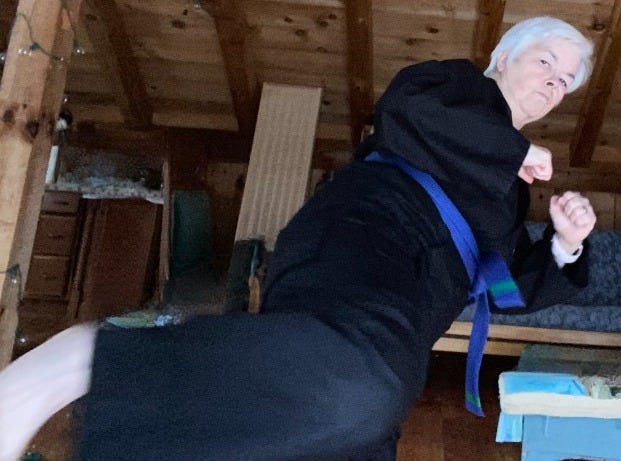
Now I take two classes a week. I am one of two female adults in classes of men. I don’t care. I am older than every other student by decades. Smaller, too. I don’t care about any of that.
My journey is different now. My knees bother me; they never used to. Thankfully, an orthopedist told me I just have some arthritis. He gave me a list of exercises to strengthen muscles supporting the knees and encouraged me to keep taking my classes. There’s a lot of memorization in karate, and the tricks of recall that worked at 18 do not work at 68. I have made adjustments, not for the last time.
We are all on journeys. I have a writing journey; I wrote one book and am casting about for another. I am still learning how to be a grandmother, which my granddaughter Ellie assures me that she is happy to teach. (Riley, almost 3, has not yet expressed an opinion.) Bread baking is endlessly intriguing; that’s another journey.
But karate, along with writing, has spanned most of my life. Maybe, sometime in my 70s, I will have earned a black belt. Maybe not. I’m not sure it matters. The journey is its own reward, always.
I would love to hear about your individual journeys in the comments!
And this message about "the journey" is why the poem Ithaca carries such great importance for me:
Ithaka
By C. P. Cavafy
As you set out for Ithaka
hope your road is a long one,
full of adventure, full of discovery.
Laistrygonians, Cyclops,
angry Poseidon—don’t be afraid of them:
you’ll never find things like that on your way
as long as you keep your thoughts raised high,
as long as a rare excitement
stirs your spirit and your body.
Laistrygonians, Cyclops,
wild Poseidon—you won’t encounter them
unless you bring them along inside your soul,
unless your soul sets them up in front of you.
Hope your road is a long one.
May there be many summer mornings when,
with what pleasure, what joy,
you enter harbors you’re seeing for the first time;
may you stop at Phoenician trading stations
to buy fine things,
mother of pearl and coral, amber and ebony,
sensual perfume of every kind—
as many sensual perfumes as you can;
and may you visit many Egyptian cities
to learn and go on learning from their scholars.
Keep Ithaka always in your mind.
Arriving there is what you’re destined for.
But don’t hurry the journey at all.
Better if it lasts for years,
so you’re old by the time you reach the island,
wealthy with all you’ve gained on the way,
not expecting Ithaka to make you rich.
Ithaka gave you the marvelous journey.
Without her you wouldn't have set out.
She has nothing left to give you now.
And if you find her poor, Ithaka won’t have fooled you.
Wise as you will have become, so full of experience,
you’ll have understood by then what these Ithakas mean.
Go Maura....! I am in the grandstands watching you get your black belt!!! Go Maura.......I just turned 78 and walk 2 miles a day......at 50 I went back and completed my PhD at 58......At 75 you helped me decide to write opeds.......those are a couple of my journeys.