

A messenger for peace
Cal Robertson bore witness

Sometimes the most memorable experiences are the quietest.
That happened to me one week when I was working as an editor in New London, Connecticut, around 20 years ago. Much of my job at The Day, the midsized daily newspaper where I worked, involved putting together a four-page section of different viewpoints that appeared every Sunday. During slow weeks the task was challenging. I was not above sifting through the mail to see if reader contributions too lengthy to publish as letters were worth running as columns instead.
That was the case with one wordy letter, although my first, emotional impulse was to toss it in the trash. The letter went on a harangue against a fixture in the region: Cal Robertson.
Cal by then had stood for 20 years on the steps of a monument dedicated to soldiers and sailors while holding up signs. “Will Children Have a Future?” was one. Another: “No more war.” Six days a week, in brutal cold and shimmering heat, he would stand as a silent witness as cars and people passed by. Sometimes he would stand at other locations, such as the Naval Submarine Base several miles away. But he could almost always be seen near the monument dedicated to members of the military.
Cal’s quiet activism outraged the letter writer, who questioned, in a sneering way, why he didn’t find something more constructive to do.
I knew immediately that the paper should run the letter, but not without giving Cal equal time. So I walked the block or so to the monument to ask him to come to my office, when he was done with that day’s vigil, and dictate a rebuttal. It would take time. He had lingering brain damage from a blood clot and spoke very slowly.
When he came upstairs to my office, he read the letter from the irate reader, carefully set aside his signs, sat down and began, haltingly, to explain his life’s work.
Cal had been a medical corpsman in Vietnam during two deployments in the 1960s. The experiences haunted him and he regretted his youthful decision to join the military for the rest of his life. When he came home, he said, he drank for years and was hospitalized in the 1970s with the blood clot that would forever after keep him from speaking normally. After that, he got sober, and began his quiet demonstrations.
He had no animosity toward the letter writer and meant no disrespect to anyone. But his silent witness - his signs against war, against violence - was his job, he said. He lived with his parents. His disability benefits paid for his few needs. The vigils were his life’s work.
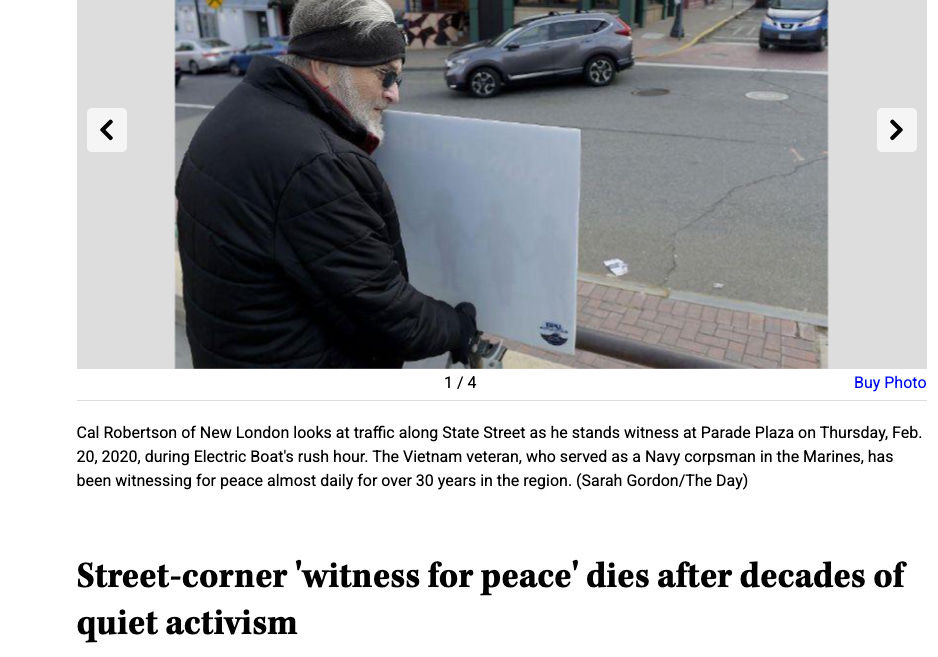
After we published both letters on the same page, there was an outpouring of support for Cal and no obvious support for the man who criticized him. People had the deepest respect for Cal, for his message and his dedication. Not everyone was a fan, of course. But whenever I saw him at his post, the thumbs-up signs and honks of support from drivers seemed to far outnumber those who didn’t like what he was doing.
Cal died Jan. 3 at the age of 80, and now there is another outpouring of support and memories from the public. One Navy veteran recalled that Cal was standing with his signs in the mid-1980s outside the submarine base when he joined the submarine force, and 26 years later when he retired, Cal was still at his post.
It has been a while since Cal was well enough to stand vigil six days a week, but he still attended the occasional demonstration for peace. At one, a woman recalled, police parked and approached the gathering. She became apprehensive. But the cops just wanted to say hello to him.
The power of example is the most underrated of all influences. Cal didn’t make moving speeches. He never ran for office. He wasn’t well known beyond a little corner of New England. But many years before “social influencer” was even a thing, he influenced others by his singular dedication to a better world. His vigils made people think. They were silent reminders that we could be better, do better. That matters. So did he.
What a heartfelt tribute to a sentinel for peace.
"The power of example is the most underrated of all influences."
Indeed, as is a ministry of presence and witness. Thanks for making him visible to more people, even in death.